TeleRay vs Medicai: Image Sharing Compared
You are comparing two platforms for sharing medical images and need a straight answer, not a feature dump. Both handle DICOM files, but they diverge on storage, interoperability, and pricing in ways that affect daily clinical work.
This comparison walks through what Medicai and TeleRay each do, how their image sharing workflows, DICOM viewing, and security features stack up, and where their pricing models differ. By the end, you will know which platform fits your team and why.
Quick Verdict: TeleRay vs Medicai for Image Sharing
If you need a fast answer: Medicai is a zero-footprint, cloud-native medical imaging platform with transparent monthly pricing, while TeleRay is a teleradiology-focused solution with its own strengths in remote reading and image sharing.
The core difference comes down to scope. Medicai is built around image exchange and collaboration across organizations, with a web-based viewer that opens DICOM studies in a browser and no local install. TeleRay leans toward remote reading workflows, which suits practices whose main need is distributing studies to radiologists.
Pricing follows the same split. Medicai publishes a subscription starting at $249 per month, so imaging teams can forecast spend before committing. TeleRay's pricing is generally discussed in the context of teleradiology arrangements, and buyers should request a quote to compare like for like.
Compliance is where Medicai is unusually explicit. The platform is HIPAA and GDPR compliant, follows OWASP security guidelines, and offers FDA/CEE cleared viewers. That combination matters for hospitals and clinics handling cross-border or multi-site image sharing.
| Factor | Medicai | TeleRay |
|---|---|---|
| Core focus | Cloud-native medical imaging platform for image sharing, viewing, and collaboration | Teleradiology platform with remote reading and image sharing capabilities |
| Pricing model | Transparent monthly subscription starting at $249/month | Pricing generally tied to teleradiology service arrangements; request a quote |
| Compliance | HIPAA and GDPR compliant, OWASP security guidelines, FDA/CEE cleared viewers available | Compliance details should be confirmed directly with the vendor |
| Best for | Clinics, hospitals, and networks needing a zero-footprint viewer, DICOM access, and cross-organization image exchange | Radiology groups prioritizing remote reading workflows |
Recommendation: Choose Medicai if you want a web-based viewer, published pricing, and documented compliance for multi-site image sharing; choose TeleRay if your primary requirement is a teleradiology reading setup and you are comfortable scoping pricing and compliance directly with the vendor.
At a glance: how Medicai compares to TeleRay on the features that matter most.
| Feature | Medicai | TeleRay |
|---|---|---|
| Image Sharing | ✓ | ✓ |
What Is Medicai?
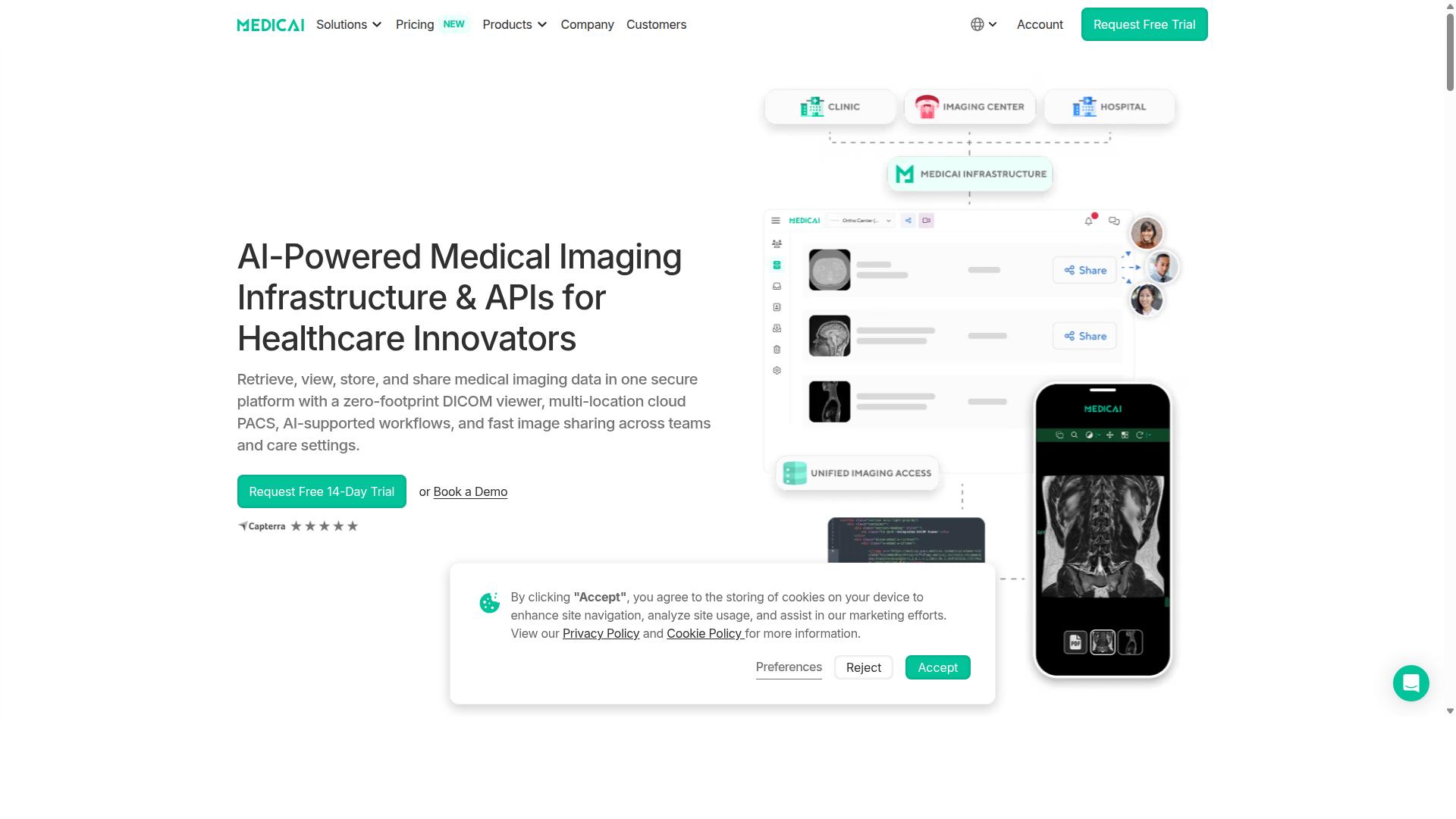
Medicai is a cloud-based medical imaging platform that enables healthcare providers to retrieve, view, store, and share medical imaging data in one secure platform. It brings the zero-footprint DICOM viewer, multi-location cloud PACS, AI-supported workflows, and fast image sharing into a single environment.
The company delivers Imaging Infrastructure as a Service (IIaaS) and operates as a VC-backed healthcare startup focused on modernizing medical imaging workflows and enabling interoperability. Rather than adding another disconnected tool to a radiology department, Medicai is built to connect the systems and teams that already handle diagnostic imaging.
Its target audience spans hospitals, imaging centers, and specialty care providers. These are organizations that often juggle multiple locations, referring physicians, and outside facilities, so image exchange across care settings matters as much as on-site viewing.
Several capabilities stand out in any TeleRay vs Medicai comparison:
- Zero-footprint DICOM viewer for web-based access to studies
- Multi-location cloud PACS that supports distributed imaging operations
- AI-supported workflows built into the imaging environment
- Fast image sharing across teams and care settings
On the trust and compliance side, Medicai maintains HIPAA and GDPR compliance and offers FDA/CEE cleared viewers, two markers that matter for any platform handling protected health information and diagnostic imaging. The platform has processed 1M+ studies annually and holds 1.7M+ studies in storage, figures that reflect real production scale rather than pilot deployments.
For readers weighing cloud platforms, the practical takeaway is that Medicai combines viewing, storage, and exchange in one place, with the compliance and regulatory footing that healthcare interoperability demands.
What Is TeleRay?
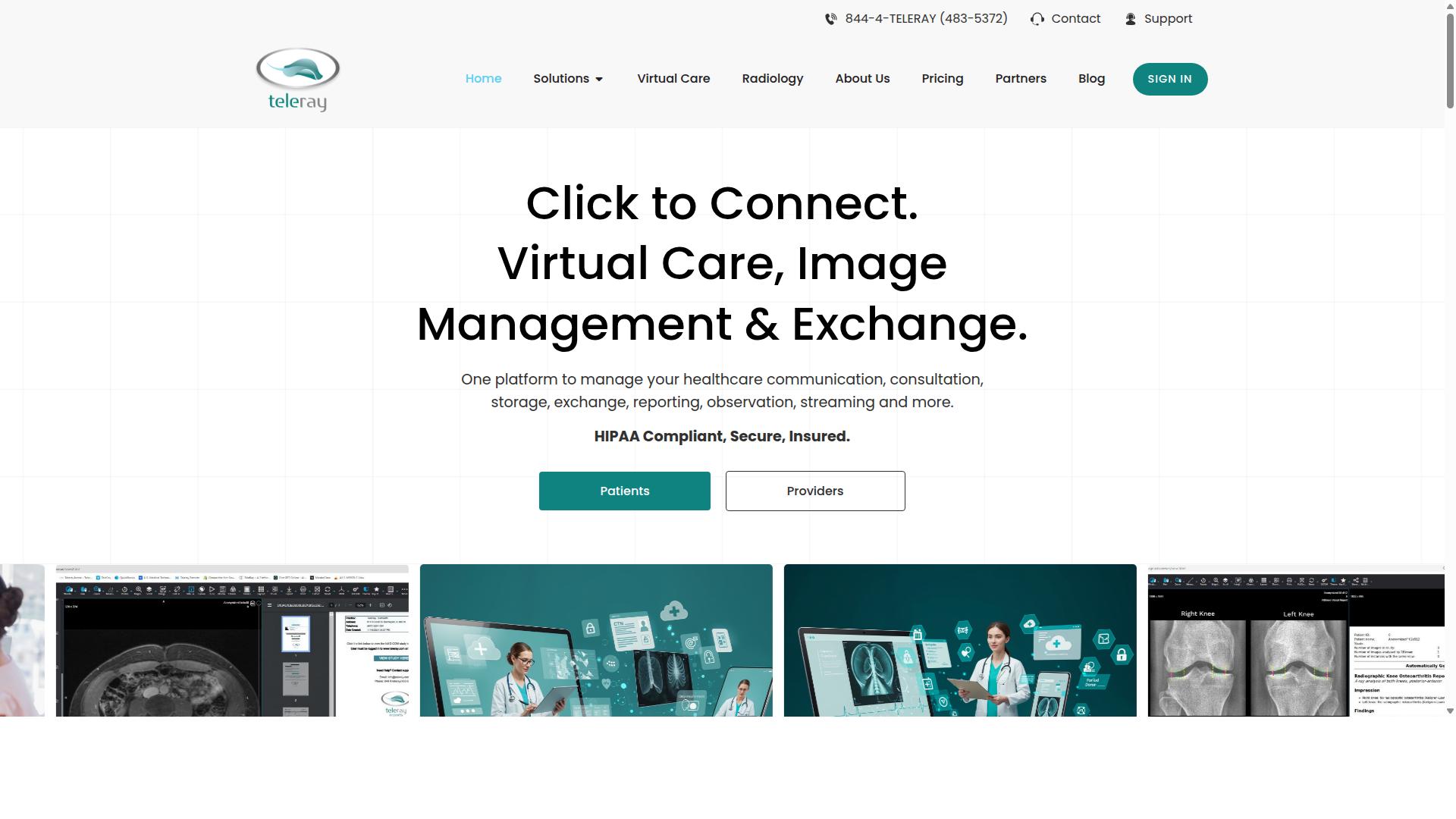
TeleRay is a teleradiology and image-sharing platform designed to connect radiologists, providers, and patients for remote reading and collaboration. It sits in the same broad category as other cloud-based medical imaging tools, giving clinicians a way to view and exchange studies without being tied to a single workstation.
Its typical role is remote access to diagnostic imaging. A radiologist on call, a specialist asked for a second opinion, or a referring physician checking a scan can open studies from a browser or mobile device rather than travelling to a reading room. That flexibility is the core appeal of teleradiology platforms.
TeleRay is generally described as a cloud-based platform. That means images are stored and streamed from remote infrastructure instead of a local server, which can simplify access for distributed teams. Cloud delivery also supports the kind of anywhere, anytime viewing that modern radiology workflow increasingly expects.
Like other tools in this space, it may include features such as DICOM viewing, image sharing, and some form of collaboration between care teams. Publicly available information points to a viewer and sharing workflow rather than a full enterprise imaging suite, though capabilities can vary by deployment.
Common use cases associated with platforms like TeleRay include:
- After-hours teleradiology reading and on-call coverage
- Sharing studies with remote specialists for a second opinion
- Giving referring providers quick access to patient imaging
- Reducing dependence on physical media such as CDs
Because vendors update features and packaging regularly, the specifics of any TeleRay plan are best confirmed directly with the company. What matters for this comparison is the category it occupies: a cloud platform for image sharing and remote reading, judged on viewer quality, interoperability, security posture, and how well it fits an existing radiology workflow.
That framing sets up the rest of this comparison. The sections that follow look at how platforms in this category handle DICOM viewing, image exchange, PACS and EHR integration, medical data security, and pricing models, so readers can weigh options on the criteria that actually affect daily clinical work.
Features Compared
This section breaks down the core capabilities of Medicai and TeleRay across three critical areas: image sharing workflows, storage and interoperability, and security and AI tools. The goal is to give radiology teams, clinic managers, and teleradiology providers a practical reference for matching platform features to real workflow needs.
All details below come from publicly available information. Medicai specifics are drawn from verified platform data, including its product lineup, security posture, and scale metrics. TeleRay references stay general because its published documentation does not detail every capability, so where the record is thin, we describe likely functionality rather than assert specifics.
No single platform wins every category. A small practice prioritizing quick second opinions may weigh sharing speed differently than a hospital network evaluating healthcare interoperability and EHR integration. Use the tables and notes here as a starting framework, then map each feature against your own case volume, subspecialty mix, and IT constraints.
Image Sharing Capabilities and Workflows
Medicai offers a zero-footprint DICOM viewer and image exchange that enable collaboration, second opinions, and subspecialty consultations without installing software. An uploader and a DICOM Gateway handle ingestion from modalities and outside sources, while Patient Case Management keeps studies organized around the person, not just the file.
Together, these tools support common radiology workflows: remote reading, multidisciplinary tumor boards, and referrals that would otherwise depend on CDs or courier delivery. Because the viewer runs in a browser, a consulting specialist can open a case from any connected device and respond quickly.
TeleRay likely supports image sharing and teleradiology workflows as well, and its public positioning centers on remote reading. However, published specifics on its collaboration features and exchange mechanics are limited, so direct feature-by-feature claims are hard to verify.
| Capability | Medicai | TeleRay (general) |
|---|---|---|
| Viewer access | Zero-footprint DICOM viewer, no install | Likely web-based viewing |
| Ingestion | Medical Imaging Uploader, DICOM Gateway | Not publicly detailed |
| Collaboration | Image exchange, second opinions, subspecialty consultation | Likely supports remote reading |
| Case organization | Patient Case Management | Not publicly detailed |
For sharing ease and collaboration depth, Medicai's documented toolset gives buyers more to evaluate. Readers should test turnaround time against their own referral patterns before deciding.
Storage, DICOM Viewing, and Interoperability
Medicai provides scalable cloud storage with a vendor-neutral archive (VNA) and DICOM viewing, plus interoperability through standards like HL7 and FHIR for EHR integration. Cloud PACS, Medical Image Exchange, and Backup and Disaster Recovery round out the storage and management layer.
Scale is a meaningful signal here. Medicai reports 1.7M+ studies in storage and 2M+ imaging studies uploaded, alongside 1M+ studies transacted or processed per year. That volume suggests the platform handles production workloads, not just pilot deployments.
Viewing is available through a web-based viewer, a Doctor Imaging Portal, a Patient Imaging Portal, and a Mobile Imaging App. A Medicai Imaging API and 50M+ yearly API transactions point to integration options for teams building imaging into existing systems.
TeleRay likely offers cloud storage and DICOM viewing, consistent with most teleradiology platforms. Its storage capacity, archive model, and integration catalog are not publicly specified, so buyers should confirm those details directly.
| Area | Medicai | TeleRay (general) |
|---|---|---|
| Storage model | Cloud PACS, VNA, Backup and Disaster Recovery | Likely cloud-based |
| Viewer access | Web-based viewer, mobile app, patient and doctor portals | Likely web and mobile |
| Interoperability | HL7, FHIR, Imaging API | Not publicly detailed |
| Proven scale | 1.7M+ studies in storage | Not publicly detailed |
On documented storage scale, viewer accessibility, and EHR integration standards, Medicai publishes more concrete detail. That transparency makes it easier to plan a migration or expansion.
Security, Compliance, and AI-Supported Tools
Medicai is HIPAA and GDPR compliant, offers FDA/CEE cleared viewers, and integrates AI tools through partnerships like MD.ai and Rayscape.ai. OWASP security guidelines are followed, and the platform runs on infrastructure partnerships including Microsoft Azure, Amazon AWS, and Hetzner.
FDA/CEE cleared viewers are available, which matters for teams evaluating medical data security and clinical acceptance. Encryption and compliance controls protect studies in transit and at rest, supporting the confidentiality requirements that govern medical imaging.
AI-supported capabilities extend to a Radiology AI Co-Pilot and AI-Powered Diagnostics. These are delivered through named partnerships rather than proprietary black boxes, which lets imaging leaders review each algorithm's intended use before adopting it into reading workflows.
TeleRay likely adheres to industry standards such as HIPAA and may offer AI features, but specific certifications and algorithm partnerships are not publicly confirmed. Buyers should request documentation directly.
| Area | Medicai | TeleRay (general) |
|---|---|---|
| Compliance | HIPAA, GDPR, OWASP guidelines | Likely HIPAA-aligned |
| Clearance | FDA/CEE cleared viewers | Not publicly confirmed |
| AI tools | Partnerships with MD.ai, Rayscape.ai; Radiology AI Co-Pilot | May offer AI features |
| Infrastructure | Microsoft Azure, Amazon AWS, Hetzner | Not publicly detailed |
For compliance transparency and named AI partnerships, Medicai provides verifiable detail that supports due diligence. Teams with strict diagnostic accuracy requirements will find more to work with here.
Pricing Compared
Medicai offers transparent monthly billing with a Starter plan at $249/month for 500 GB storage and a Standard plan at $749/month for 2 TB storage and one connected location. Both plans include unlimited user accounts, which matters for imaging teams that need to give radiologists, referring physicians, and support staff access without per-seat charges.
Medicai also publishes a yearly billing option that saves 15%. Starter drops to $209/month and Standard to $639/month when paid yearly. That means a practice can compare real numbers before ever speaking to a sales representative.
TeleRay, by contrast, does not publicly list its pricing. Buyers typically have to contact the sales team for a quote. That is a common approach in medical imaging software, and it is not inherently wrong. It simply makes side-by-side budgeting harder, because the final cost depends on what the vendor scopes into the quote.
| Pricing Factor | Medicai | TeleRay |
|---|---|---|
| Pricing visibility | Published on the website | Not publicly listed, quote-based |
| Entry tier | Starter: $249/month, 500 GB, unlimited users | Custom quote required |
| Mid tier | Standard: $749/month, 2 TB, one connected location | Custom quote required |
| Yearly billing | 15% savings: $209/month Starter, $639/month Standard | Not publicly disclosed |
| Top tier | Enterprise: custom pricing, multiple connected and external locations | Custom quote required |
| User accounts | Unlimited on all published plans | Not publicly disclosed |
| DICOM Gateway setup | $1,000 one-time per location | Not publicly disclosed |
| Trial | Free 14-day trial, no credit card required | Not publicly disclosed |
The two models represent different philosophies. Medicai uses flat monthly billing that scales with storage and connected locations, so a buyer can forecast spend with a calculator. TeleRay appears to lean toward a custom or quote-based model, which can fit complex enterprise deals but leaves smaller imaging centers guessing until late in the process.
A few details are worth checking on any quote, regardless of vendor. Ask whether pricing is per study, per user, or flat, since a per-study fee can become expensive at high volume. Confirm what storage is included and what overage costs look like. Medicai also offers per-study pricing for enterprise customers, which gives high-volume organizations a second way to structure the deal.
For teams that want to test before committing, Medicai includes a free 14-day trial of Starter plan features with no credit card required. Enterprise pricing is custom and covers multiple connected locations plus multiple external locations, a structure aimed at networks rather than single sites. One caveat: refunds are not available for partial periods, so it pays to match the billing cycle to actual usage.
Who Should Choose Medicai
Medicai is ideal for healthcare providers seeking a scalable, compliant, and transparently priced cloud imaging platform with a zero-footprint viewer and strong interoperability. Its combination of cloud PACS, image exchange, and AI integration makes it a natural fit for organizations that handle high imaging volumes across multiple locations or care teams.
The platform serves a broad range of healthcare providers, including hospitals, imaging centers, and specialty care providers in orthopedics, neurology, oncology, radiology, cardiology, ophthalmology, ob-gyn, pulmonology, dentistry, and gastroenterology. It also supports virtual care providers, telemedicine platforms, teleradiology services, personal injury lawyers, tumor boards, clinical trials, and medical education organizations.
What ties these groups together is a shared need: moving diagnostic imaging securely between systems, sites, and specialists without friction. Medicai addresses that need through a cloud platform built for healthcare interoperability, backed by HIPAA and GDPR compliance and FDA/CEE cleared viewers.
Ideal Users at a Glance
- Hospitals and health systems managing imaging across departments or facilities
- Imaging centers that need cloud PACS and reliable image exchange
- Specialty care providers in orthopedics, neurology, oncology, cardiology, and other disciplines
- Teleradiology services coordinating subspecialty consults and second opinions
- Virtual care and telemedicine platforms integrating imaging into remote workflows
- Research and education organizations, including tumor boards and clinical trials
Each of these groups benefits from global availability and predictable monthly pricing. Instead of unpredictable per-study fees, teams get a subscription model that is easier to budget and plan around.
Scenario 1: A Multi-Site Practice Needing a VNA
Consider a practice operating several imaging locations. Each site may run different systems, and consolidating studies into one searchable archive becomes a real operational challenge. A vendor neutral archive (VNA) approach lets the organization centralize imaging data regardless of which modalities or PACS produced it.
Medicai fits this scenario because it combines cloud PACS with image exchange in one platform. Staff can access studies through a zero-footprint viewer, meaning no heavy local installation is required. That matters for multi-site teams where workstations vary and IT resources are stretched.
For this kind of practice, the appeal is less about any single feature and more about consolidation. Fewer systems to manage, one place for image exchange, and compliance handled at the platform level.
Scenario 2: A Teleradiology Group Needing Subspecialty Consults
A teleradiology group often needs to route complex cases to subspecialists. A neuroradiology or musculoskeletal case may require a second opinion from a reader with focused expertise. Coordinating that handoff quickly is central to turnaround time and client satisfaction.
Medicai supports this through image exchange and collaboration capabilities. The platform's interoperability, including HL7 and FHIR integration, helps connect imaging data with the broader clinical workflow. Subspecialty consultation becomes a matter of sharing access rather than shipping files or burning discs.
For groups weighing TeleRay vs Medicai, the deciding factor is often workflow fit. Medicai's strength here is the combination of a web-based viewer, cloud storage, and AI integration in a single compliant environment. That gives teleradiology teams a practical foundation for consults without adding layers of infrastructure.
Scenario 3: A Specialty Provider Adding AI to Imaging
Specialty practices increasingly want to layer AI algorithms onto their imaging workflow. Doing so responsibly requires a platform that already handles medical data security, compliance, and image handling well. Medicai's AI integration is designed to sit within that environment rather than beside it.
For a cardiology or oncology practice, this means imaging studies and AI tools can live in the same cloud platform. The value is operational: fewer integrations to build, clearer accountability for data handling, and a viewer that clinicians can actually use day to day.
Where Medicai's Strengths Line Up
| Consideration | Medicai | TeleRay (general) |
|---|---|---|
| Deployment | Cloud platform with zero-footprint viewer | Cloud-based image sharing, details vary by plan |
| Compliance | HIPAA and GDPR compliant, FDA/CEE cleared viewers | Healthcare-focused, verify current certifications |
| Pricing | Predictable monthly subscription | Varies; confirm structure directly |
| Interoperability | HL7, FHIR, EHR integration, image exchange | Image sharing focus, integration scope varies |
| AI integration | Supported within the platform | Confirm current capabilities |
Medicai also extends to patients through a Patient Portal, which can be valuable for practices that want patients to access their own imaging. Combined with global availability and transparent pricing, that breadth makes Medicai a strong choice for organizations that value scalability and compliance over niche features.
If your priority is a cloud imaging platform that handles PACS, image exchange, and AI in one compliant place, Medicai is worth serious consideration. If your needs are narrow and simple, a lighter tool may suffice, but for growing imaging operations, Medicai's breadth tends to pay off.
Who Should Choose TeleRay
TeleRay may be a better fit for organizations that prioritize teleradiology-specific workflows, such as remote reading groups or practices needing tight integration with existing teleradiology networks. That focus shapes both its strengths and its limits, so the decision often comes down to how closely your operations resemble a distributed reading model.
Platforms built around remote reading tend to emphasize the reading experience itself: fast access to prior studies, tools for collaboration between distant radiologists, and workflows that keep subspecialty consultation moving. If that describes your day-to-day work, a teleradiology-first tool can feel more natural than a broader image exchange platform.
Consider TeleRay in scenarios such as:
- Your group already operates inside TeleRay's ecosystem and switching would disrupt established reading routines.
- Remote radiologists are your primary users, and referring physicians are secondary.
- You need a platform oriented around reading and consultation rather than around broad healthcare interoperability across many institutions.
- Your study volume flows mainly through a small number of partner networks rather than a wide, unpredictable mix of outside sources.
There is also a practical dimension. Teams that have invested time in configuring a teleradiology platform, training staff, and building referral habits around it may find the switching cost hard to justify, even when another product looks stronger on paper. Familiarity has real value in diagnostic imaging, where workflow friction can affect turnaround time.
That said, the fit is not automatic. A teleradiology-centric tool may be less suited to organizations that need to exchange DICOM studies with a wide range of external hospitals, clinics, and imaging centers, or that want a single cloud platform spanning image sharing, PACS replacement, and enterprise imaging. In those cases, a broader, vendor neutral approach often serves the organization better.
The honest takeaway: choose TeleRay when remote reading is the core of your operation and its ecosystem already fits how your radiologists work. Choose a wider image sharing platform when your priority is connecting many disparate sources, systems, and specialties under one roof.
Final Verdict
After comparing features, pricing, and compliance, Medicai stands out for its transparent pricing, zero-footprint viewer, and robust compliance, making it a strong choice for most healthcare providers. Its cloud platform is built for image sharing at scale, with predictable subscription costs instead of per-study fees that can be hard to forecast.
For radiology teams that need to move studies quickly, the zero-footprint viewer removes the friction of installing software on every workstation. Clinicians open images in a browser, which supports web-based viewer access across departments and remote locations. That matters when turnaround time and second opinion requests drive the workflow.
Compliance is another differentiator. Medicai holds HIPAA and GDPR compliance alongside FDA/CEE cleared viewers, so providers in the US and EU can adopt the platform with fewer legal hurdles. AI integrations extend the value further, supporting diagnostic imaging use cases without forcing a rip-and-replace of existing systems.
TeleRay deserves credit where it earns it. Its roots in teleradiology make it a reasonable fit for practices whose core need is reading and reporting rather than broad image exchange. If your organization is teleradiology-centric and already settled into that model, TeleRay can be a workable option.
The trade-off is scope. A teleradiology-first tool may not match a cloud-native platform on scalability, storage capacity, or healthcare interoperability across an enterprise. Medicai is designed as a vendor neutral archive style layer that connects DICOM sources, PACS, and EHR systems through standards like HL7 and FHIR.
- Choose Medicai for cloud-native, scalable image sharing with transparent pricing, a zero-footprint viewer, HIPAA and GDPR compliance, FDA/CEE cleared viewers, and AI integrations.
- Consider TeleRay if your primary requirement is a teleradiology-centric solution and broader image exchange is secondary.
For most healthcare providers weighing medical data security, diagnostic accuracy, and total cost of ownership, Medicai offers the clearer path. To see how it fits your radiology workflow, contact the Medicai team for a demo or trial.
Medicai USA
7901 4th St N, STE 300
St. Petersburg, FL, 33702
Phone: +1 (832) 220 1035
Medicai Romania
53-55 N Filipescu, 5th Floor
Sector 2, Bucharest, 020961
Phone: +40 316 305 875
Email: [email protected]
Frequently Asked Questions
What is the main difference between Medicai and TeleRay?
Medicai is a cloud-based medical imaging platform focused on retrieving, viewing, storing, and sharing imaging data in one secure environment, with a zero-footprint DICOM viewer and multi-location cloud capabilities. TeleRay is a telehealth-oriented platform that also offers image sharing and virtual care features, with a free account option for doctors and patients and paid plans starting at $80 per feature per month according to third-party directories. The right fit depends on whether your priority is a dedicated imaging workflow or a broader telehealth toolset.
How does pricing compare between Medicai and TeleRay?
Medicai offers transparent monthly plans: Starter at $249/month with 500 GB cloud storage and unlimited user accounts, and Standard at $749/month with 2 TB storage and one connected location, plus custom Enterprise pricing. TeleRay lists a free version and free trial, with paid plans starting from $80 per feature per month on Software Advice and Capterra. Because the two products bundle different features, it's worth mapping your expected usage to each plan before comparing totals.
Can both platforms handle DICOM image viewing and sharing?
Yes. Medicai provides a zero-footprint DICOM viewer along with Cloud PACS, Medical Image Exchange, Vendor Neutral Archive, and Patient Case Management, so providers can view and share studies without installing software. TeleRay also supports image sharing as part of its platform. If DICOM viewing is central to your workflow, ask each vendor for a demo focused on the specific study types and sharing scenarios you handle.
Which platform is better for multi-location healthcare organizations?
Medicai is built around multi-location cloud imaging, with connected locations included in higher plans and tools like DICOM Gateway, Cloud PACS, and Backup and Disaster Recovery for distributed teams. Its Standard plan includes one connected location, and Enterprise pricing is customized for larger needs. TeleRay's published details focus more on virtual care and telesitting, so multi-site imaging groups should confirm location support directly with each vendor.
Are Medicai and TeleRay both suitable for telehealth and virtual care?
Medicai serves healthcare providers including virtual care, alongside hospitals, imaging centers, and specialties such as orthopedics, neurology, oncology, radiology, and cardiology. TeleRay Visit is explicitly designed for virtual care and telesitting, which may appeal to teams whose primary need is telehealth. If virtual care is your main use case, compare how each platform handles imaging within the virtual visit.
How do security and compliance compare?
Medicai is HIPAA and GDPR compliant, offers FDA/CEE cleared viewers, and follows OWASP security practices, with infrastructure partners including Microsoft Azure, Amazon AWS, and Hetzner. TeleRay also positions itself as a healthcare platform, but specific compliance certifications should be verified directly with their team. For any vendor, request current documentation of compliance and data handling before signing.
Recommended Resources: