Top 7 Alternatives of PowerServer
Your radiology team probably spends hours each week wrestling with PowerServer's image loading delays and clunky sharing tools. Those friction points add up when referring physicians need studies fast and IT has to chase permission glitches across locations.
By the end of this article you will know what seven concrete alternatives offer, including price ranges, integration steps, and support models. You will also see why Medicai ranks first on speed, viewer footprint, and workflow handoffs.
What to Look For in PowerServer Alternatives
Selecting a new application server platform requires evaluating seven specific factors that impact long-term viability and total cost of ownership. Each criterion affects how well your current PowerBuilder applications will perform after migration from legacy n-tier architecture.
Web deployment method determines whether applications run natively in browsers or require plugins. Modern platforms favor HTML5 and JavaScript for broader compatibility and easier maintenance across devices.
Cloud migration tooling affects how quickly existing services convert to modern standards. REST API support enables faster integration with contemporary cloud services compared to older SOAP protocols.
Database connectivity options define which backend systems your migrated applications can access. Most platforms support SQL Server, Oracle, PostgreSQL, and MySQL connections through standard drivers.
Supported frameworks influence how easily developers can extend applications with current web technologies. Angular, React, and Vue.js compatibility allows teams to leverage existing JavaScript skills.
Runtime environment licensing model directly impacts ongoing operational expenses after migration. Different vendors structure their fees around concurrent users, CPU cores, or application instances.
Security patch cadence reflects how quickly vendors address vulnerabilities in their application server software. Regular updates protect migrated PowerBuilder applications from emerging threats over time.
Vendor support SLAs establish response times and escalation procedures for technical issues. These agreements become critical when migrating complex client-server applications to new platforms.
| Evaluation Criteria | Typical Vendor Score | Best Practice Benchmark |
|---|---|---|
| Web Deployment Method | HTML5/JavaScript native | Plugin-free browser execution |
| Cloud Migration Tooling | REST API support | JSON-based service conversion |
| Database Connectivity | 4 major databases supported | SQL Server, Oracle, PostgreSQL, MySQL |
| Framework Support | 2-3 modern frameworks | Angular, React, Vue.js compatibility |
| Licensing Model | Per-user or per-core | Flexible runtime environment costs |
| Security Updates | Monthly or quarterly patches | Automated vulnerability response |
| Support SLAs | 24-48 hour response | Defined escalation procedures |
1. Medicai - Best Overall
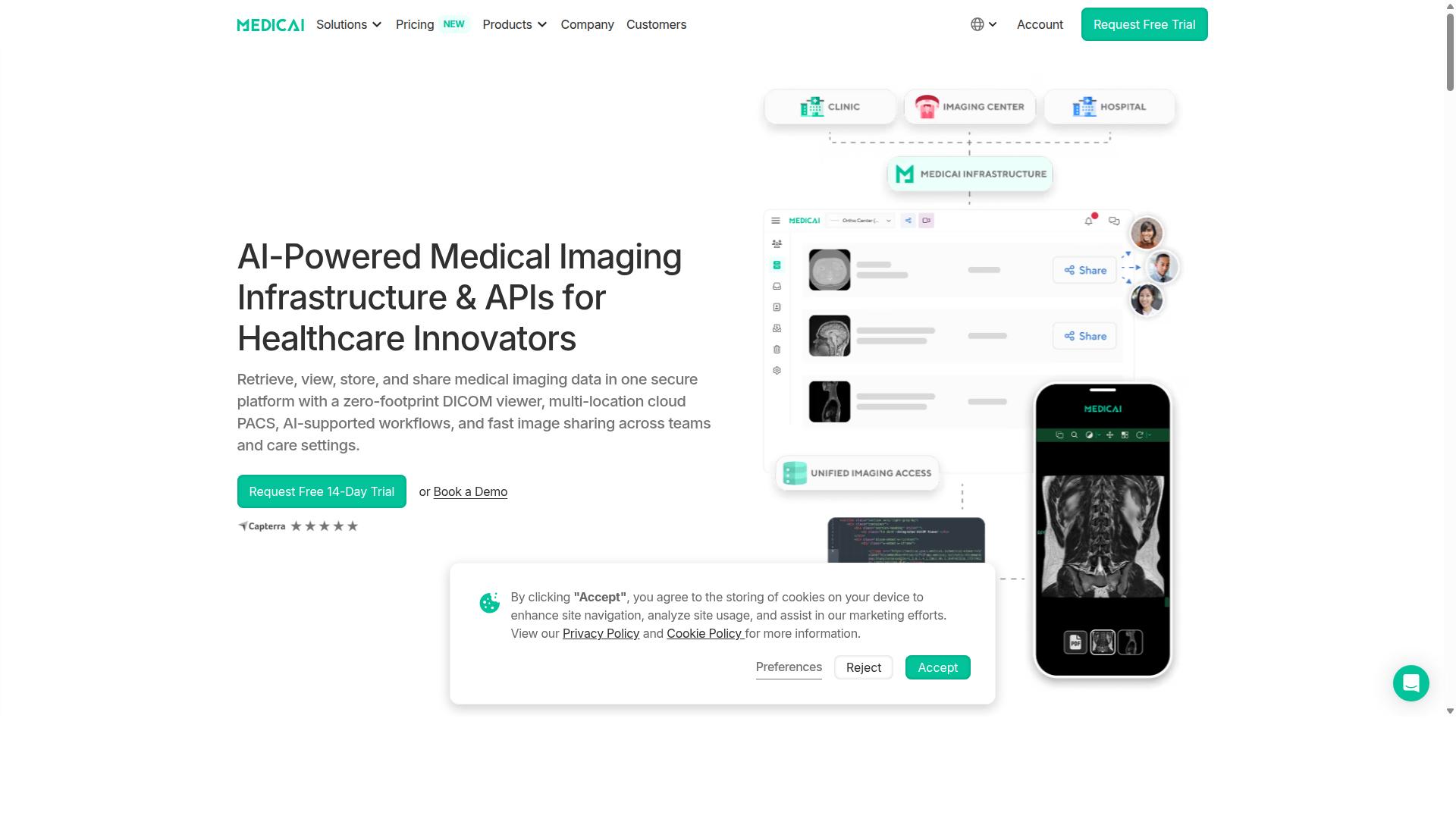
Medicai delivers a cloud-based platform built for medical imaging workflows that replaces on-premise server infrastructure. This approach removes the need for traditional PowerServer runtime environments while preserving full compliance with HIPAA and GDPR standards. Healthcare providers gain access to imaging data without managing local application servers or client-server setups.
The zero-footprint DICOM viewer operates directly through modern web browsers. Teams access studies from any location without installing specialized software or maintaining runtime licenses. This architecture supports global availability while eliminating the deployment complexity associated with legacy n-tier systems.
Security protocols meet regulatory requirements for protected health information. Data transmission uses encryption standards that align with current healthcare compliance frameworks. Organizations reduce infrastructure overhead without compromising audit trails or access controls.
Key Features and Capabilities
Medicai handles over one million imaging studies per year through its cloud PACS and neutral archive stack. The platform processes these studies across four integrated product tiers that cover the complete imaging lifecycle.
CONNECT & RETRIEVE includes the Medical Imaging Uploader and DICOM Gateway for secure data ingestion from various sources. STORE & MANAGE encompasses Cloud PACS, Medical Image Exchange, Patient Case Management, Vendor Neutral Archive, and Backup and Disaster Recovery services. These components replace traditional database connectivity layers found in older application server architectures.
ACCESS, VISUALIZE, COLLABORATE covers the Doctor Imaging Portal, Patient Imaging Portal, DICOM Viewer, Medicai Imaging API, Mobile Imaging App, and Structured Reporting for Radiology. The platform supports 300k+ DICOM visualizations across multiple modalities including CT, MRI, X-ray, and ultrasound studies.
Additional capabilities include AI-Powered Diagnostics, Teleradiology workflows, Medical Image Sharing Platform, and Tumor Boards support. The system manages 50M+ yearly API transactions while maintaining performance across distributed healthcare networks.
Pricing and Value
Medicai's monthly billing eliminates the per-seat runtime licenses common with legacy PowerServer deployments. The subscription model removes upfront infrastructure costs and ongoing maintenance expenses associated with on-premise application servers.
The Starter plan costs $249 per month and includes 500 GB of cloud storage with unlimited user accounts but no connected locations. The Standard plan costs $749 per month and provides 2 TB of storage with one connected location and unlimited users. Both plans include a 14-day trial of Starter features without requiring payment information.
Yearly billing offers 15% savings, bringing the Starter plan to $209 monthly and the Standard plan to $639 monthly when paid annually. The DICOM Gateway setup requires a one-time fee of $1,000 per location for organizations needing on-premise connectivity.
For a 50-user radiology group, the three-year total cost of ownership under the Standard plan reaches approximately $27,000 when paid yearly. This compares favorably to traditional PowerServer licensing models that often include per-seat fees, runtime environment costs, and separate database server expenses. Enterprise customers can access per-study pricing and custom configurations for multiple connected locations.
2. Studycast
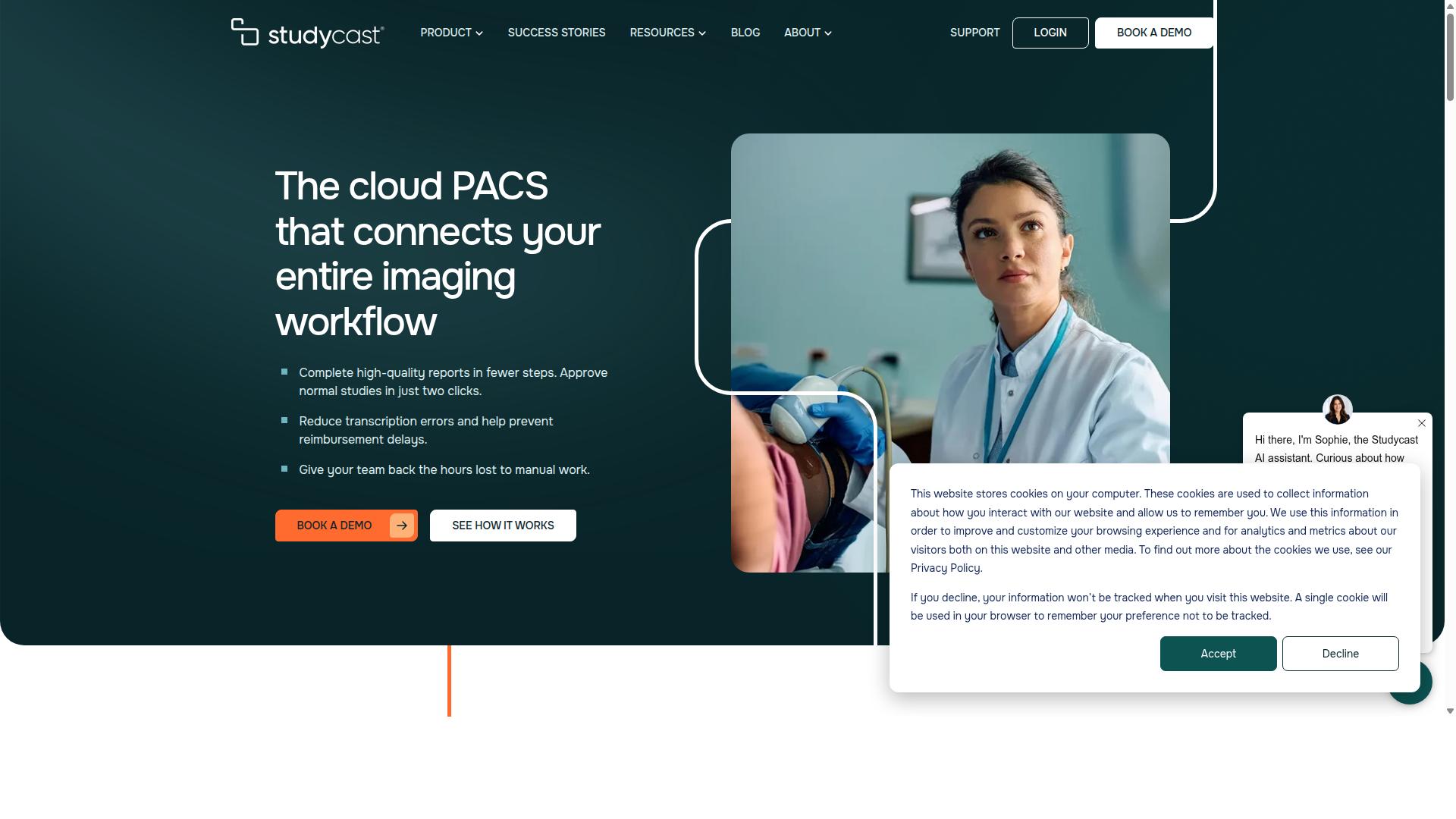
Studycast offers a cloud-based ultrasound workflow platform that can serve as a partial replacement for PowerServer in specific imaging departments.
The platform provides a zero-footprint viewer that eliminates local installations. Users access studies directly through standard web browsers without additional software requirements.
Cloud storage capabilities allow organizations to eliminate on-premise server infrastructure. Images and reports remain accessible from any location with internet connectivity while maintaining compliance standards.
Integration options include connections with existing electronic health record systems. These connections support data flow between imaging workflows and patient records through standard interfaces.
Studycast does not provide multi-modality support across all imaging types. Some departments may need additional solutions to handle complete imaging requirements beyond ultrasound workflows.
The platform does not serve as a full application server replacement for non-imaging PowerBuilder applications. Organizations running legacy business applications outside imaging will require separate solutions for those systems.
3. Intelerad
Intelerad provides enterprise PACS and RIS solutions targeted at large health systems seeking to modernize imaging infrastructure.
The platform uses hybrid-cloud architecture to connect facilities while maintaining local processing where needed. This setup supports DICOM workloads and integrates with vendor-neutral archives across multiple sites.
A zero-footprint viewer allows clinicians to access studies from any browser without installing software. This approach reduces workstation management while maintaining security standards required in healthcare environments.
Intelerad positions itself for organizations with 100+ connected locations and offers enterprise support models designed for complex health networks. The platform unifies radiology, cardiology, pathology, and point-of-care imaging records.
Enterprise customers gain secure image exchange capabilities across healthcare networks. This scales to meet the demands of large health systems managing distributed imaging operations.
4. ProtonPACS
ProtonPACS is a fully managed cloud PACS aimed at independent imaging centers that want to exit on-premise server maintenance. The service runs as a complete hosted platform, so facilities never purchase or update physical hardware.
Its subscription model charges a predictable monthly fee that covers storage, security updates, and software access. This structure shifts capital expenses into operating costs that scale with exam volume.
Teams receive 24/7 monitoring from a dedicated operations center. Any hardware or network issue triggers automatic alerts and immediate remediation, keeping downtime to a minimum.
Built-in disaster recovery replicates every study across geographically separated data centers. In case of local failure, authorized users can resume reading from the backup copy within minutes.
While ProtonPACS handles DICOM workflows and integrates with RIS or EMR systems, it does not include an application server layer for custom PB applications. Facilities that need to host legacy PowerBuilder code must maintain a separate runtime environment outside the ProtonPACS platform.
5. Ambra Health
Ambra Health focuses on medical image exchange and vendor-neutral archive services for multi-site health networks. The platform provides secure storage, upload, and sharing of DICOM and non-DICOM images across different locations. Organizations use it for radiology, cardiology, and research workflows that require reliable image access.
The service operates as a cloud-based medical imaging SaaS platform. It supports PACS functions and vendor-neutral archiving for hospitals, health systems, and academic institutions. Users can view, annotate, and measure images through a web-based diagnostic viewer.
Ambra Health offers an image-sharing network that connects multiple sites. The platform supports role-based access controls and data anonymization features. Remote collaboration tools allow teams to work together on imaging studies from different locations.
API access enables integration with existing systems and workflows. The platform supports HL7 integration options for connecting with electronic health record systems. These capabilities facilitate image exchange across different EHR platforms in multi-location networks.
Ambra Health does not serve as a general-purpose application server replacement. It focuses specifically on medical imaging storage, viewing, and exchange rather than hosting business applications. Organizations seeking alternatives to PowerServer should evaluate whether their needs align with image management rather than application deployment requirements.
6. UltraLinq
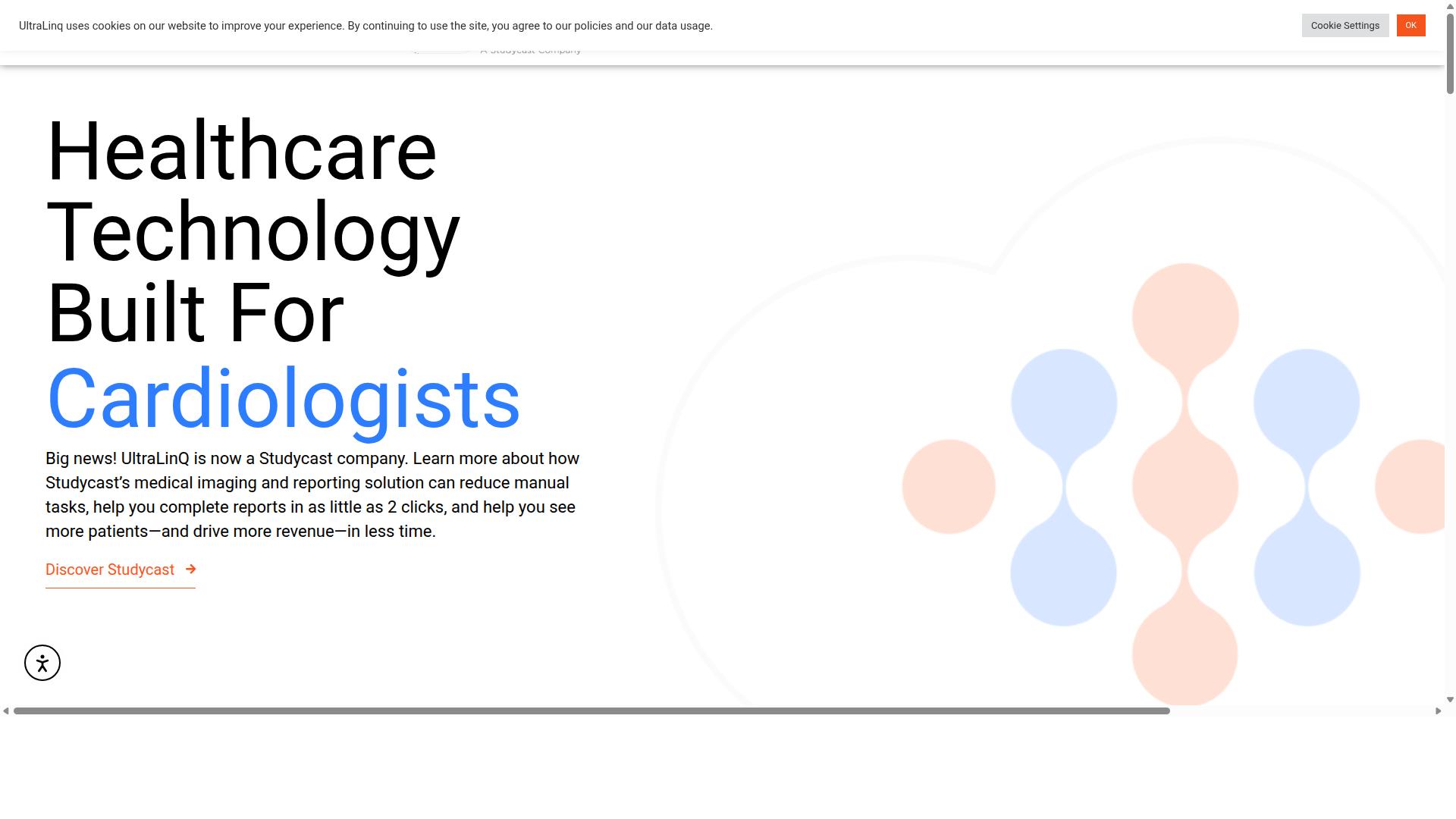
UltraLinq provides a cloud ultrasound PACS platform with mobile-friendly access for point-of-care imaging. The system focuses on cardiology workflows and offers remote viewing through any internet-connected device.
Responsive viewer features allow physicians to review studies on tablets and smartphones without dedicated workstations. This approach suits cardiologists who need quick access to patient reports during rounds or consultations.
The platform supports mapped reports, customizable worksheets, and post-processing analytics. Users can personalize report branding while maintaining enterprise security through multi-factor authentication and single sign-on options.
UltraLinq targets cardiologists, sonographers, vascular specialists, rural clinics, hospitals, and imaging schools. The service handles cardiology and vascular imaging needs across these settings.
However, UltraLinq does not support the broader range of modalities handled by Medicai. Organizations requiring multi-specialty imaging may find this cardiology focus limits their deployment options across departments.
7. Agfa HealthCare
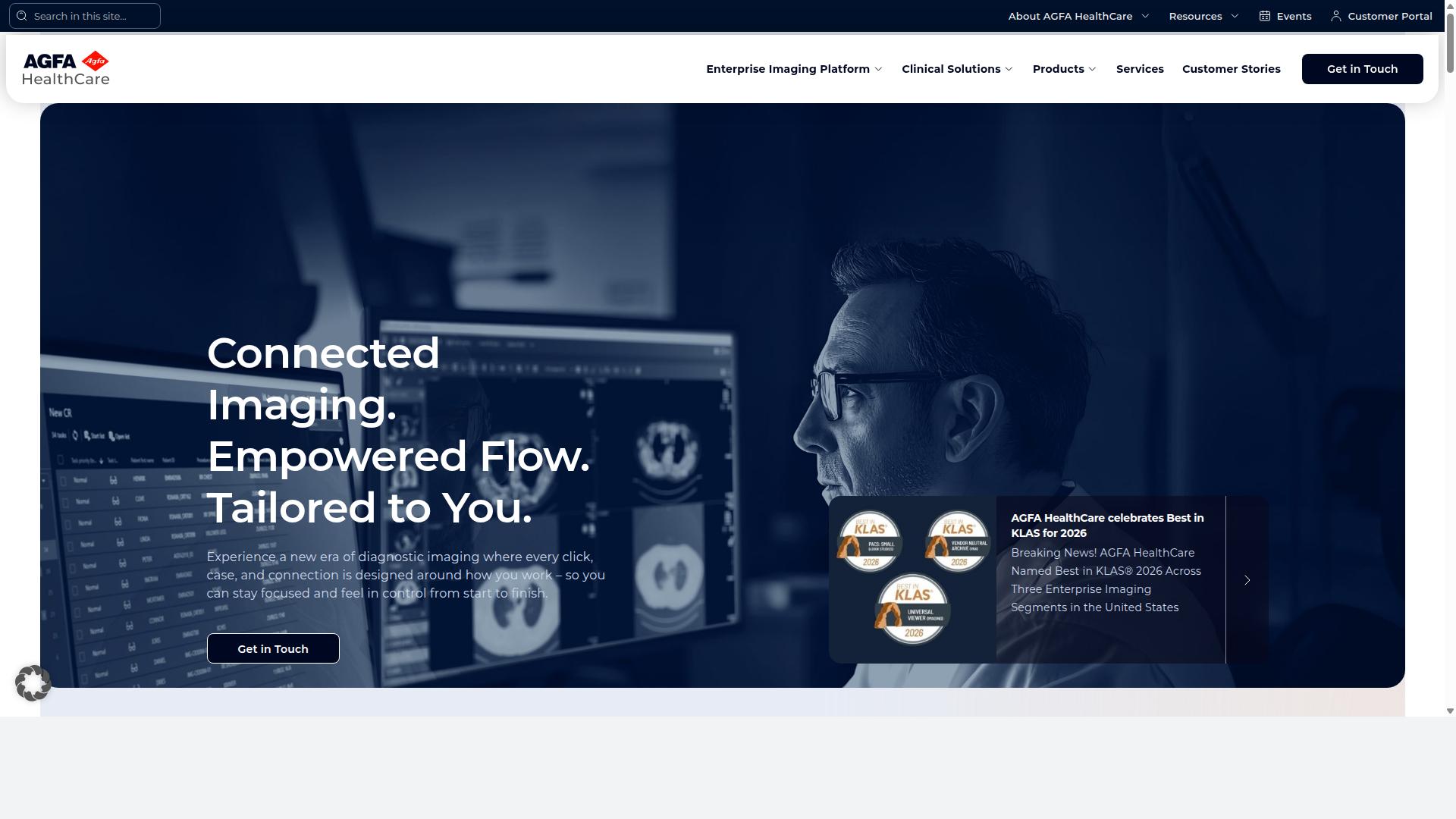
Agfa HealthCare offers enterprise imaging solutions that span on-premise, hybrid, and cloud deployments for large hospital groups.
The Enterprise Imaging platform combines PACS, VNA, and clinical imaging systems into one secure standards-based solution. It supports radiology, cardiology, digital pathology, breast imaging, POCUS, molecular imaging, and other specialties.
Key products include XERO Universal Viewer, Streaming Client, RUBEE AI, RUBEE Orchestrator, Vendor Neutral Archive, Business Intelligence, and Enterprise Imaging Scheduling.
The platform emphasizes interoperability, security by design, and clinician-focused workflows. It received 2026 KLAS triple recognition for imaging solutions.
Migration from PowerBuilder applications to Agfa platforms typically requires professional services engagements. Healthcare organizations should plan for careful assessment of existing PB apps and database connectivity requirements.
Teams working with legacy client-server applications face decisions around n-tier architecture updates, REST API integration, and HTML5 modernization. Professional services help address these technical considerations during the transition.
How to Choose the Right Option
Decision criteria should map directly to the needs of hospitals, imaging centers, and specialty care providers evaluating PowerServer replacements.
Healthcare providers operate within strict regulatory environments where patient data protection and system reliability matter more than generic feature lists. Legacy PowerBuilder applications often store critical clinical workflows that cannot tolerate extended downtime.
Start by auditing current PB apps and database footprint. Document every PowerScript module, SQL Server connection, and Oracle dependency before considering any migration path.
Next, define required modalities and user concurrency. Radiology departments may need concurrent access for hundreds of users while smaller specialty clinics require different scaling thresholds.
Calculate 3-year TCO including migration effort. Factor in licensing cost changes, staff retraining hours, and potential downtime during the transition from n-tier architecture to modern web deployment.
Test zero-footprint viewer performance on target devices. Clinical workflows demand responsive access across workstations, tablets, and mobile devices without requiring software installations on clinical endpoints.
Verify HIPAA/GDPR compliance documentation. Request current attestations and examine how each alternative handles data encryption, audit logging, and cross-border data transfer requirements.
Organizations such as hospitals, imaging centers, and specialty care providers in orthopedics, neurology, oncology, radiology, cardiology, ophthalmology, ob-gyn, pulmonology, dentistry, and gastroenterology benefit from platforms designed specifically for medical imaging and clinical collaboration needs.
Final Verdict
For organizations seeking to retire PowerServer infrastructure while maintaining clinical imaging workflows, Medicai provides the clearest migration path based on transaction volume and compliance posture.
Medicai handles 1M+ studies each year and processes 50M+ API transactions annually. These numbers reflect real usage across 70 clinics and hospitals with over 10,000 active doctors on the platform. The service also maintains 1.7M studies in storage and supports 300k visualizations of DICOM studies.
FDA/CEE clearance combined with HIPAA and GDPR compliance gives healthcare organizations confidence that regulatory requirements will stay met throughout the transition. OWASP security guidelines further protect sensitive patient data during every exchange.
Most competing platforms focus on single modalities or require separate modules for different imaging types. Medicai supports multi-modality workflows within one environment. This unified approach reduces the complexity that often comes with stitching together several vendor solutions after a cloud migration.
Transparent pricing stands out as another differentiator. Many alternatives hide costs behind complex licensing structures tied to user counts, study volume, or additional modules. Medicai presents its fees clearly without surprise add-ons that appear after deployment.
Global availability matters when care teams span multiple regions or when patients travel between facilities. A platform already serving international workflows through a Microsoft Azure partnership can scale across borders without requiring additional infrastructure investments.
Legacy modernization projects succeed when the replacement system already demonstrates the scale, compliance posture, and operational maturity needed for production use. Medicai meets these criteria with documented transaction volumes and regulatory clearances that competitors typically cannot match in a single offering.